
NFPA Fire Alarm Inspection Requirements for Connecticut Restaurants — What Every Owner Needs to Know
NFPA fire alarm inspection requirements for Connecticut restaurants are something most restaurant owners know they're supposed to follow — but far fewer understand in detail. Annual fire alarm inspection is a legal requirement for virtually every commercial restaurant in Connecticut, and the consequences of skipping it range from compliance violations and fines to insurance claim denials and forced closure.
Grease buildup on fire alarm detectors is the single most common issue DetectionTech finds during restaurant fire alarm inspections in Connecticut — and it's something most owners don't know to look for until an inspector flags it or a device fails to respond when it should.
Here's what Connecticut restaurant owners need to know about NFPA fire alarm inspection requirements — and what to expect when DetectionTech shows up for your annual inspection.
What Is NFPA 72 and Why Does It Apply to Connecticut Restaurants
NFPA 72 is the National Fire Alarm and Signaling Code — the standard that governs the installation, inspection, testing, and maintenance of fire alarm systems across the United States. Connecticut has adopted NFPA 72 as the basis for its commercial fire alarm requirements, meaning virtually every commercial property in the state with a fire alarm system is required to comply.
For Connecticut restaurants specifically NFPA 72 requires:
Annual inspection and testing of the entire fire alarm system by a licensed fire alarm contractor
Functional testing of every smoke detector, heat detector, pull station, and notification device
Testing of the fire alarm control panel and battery backup
Verification of monitoring connection and signal transmission
Formal compliance documentation produced at the end of every inspection
The compliance report from your annual inspection is what you present to your local fire marshal, your landlord, and your insurance carrier when they ask for proof of compliance. Without it you have no documentation that your system has been inspected — even if it actually has been.
Why Restaurant Fire Alarm Inspections Are More Complex Than Standard Commercial Inspections
Restaurants present fire detection challenges that most commercial properties don't. Commercial kitchen environments — with high heat, grease-laden air, steam, and smoke from cooking — are significantly harder on fire alarm devices than office or retail environments.
The most common issues DetectionTech finds during NFPA fire alarm inspection requirements checks at Connecticut restaurants include:
Grease buildup on detectors — this is by far the most common finding. Heat and smoke detectors in kitchen environments accumulate grease over time. The buildup infiltrates the sensing chamber and compromises the device's ability to detect smoke or heat accurately. In some cases the buildup causes nuisance alarms. In others it slows response time when a real fire starts. Either way the device needs to be cleaned or replaced.
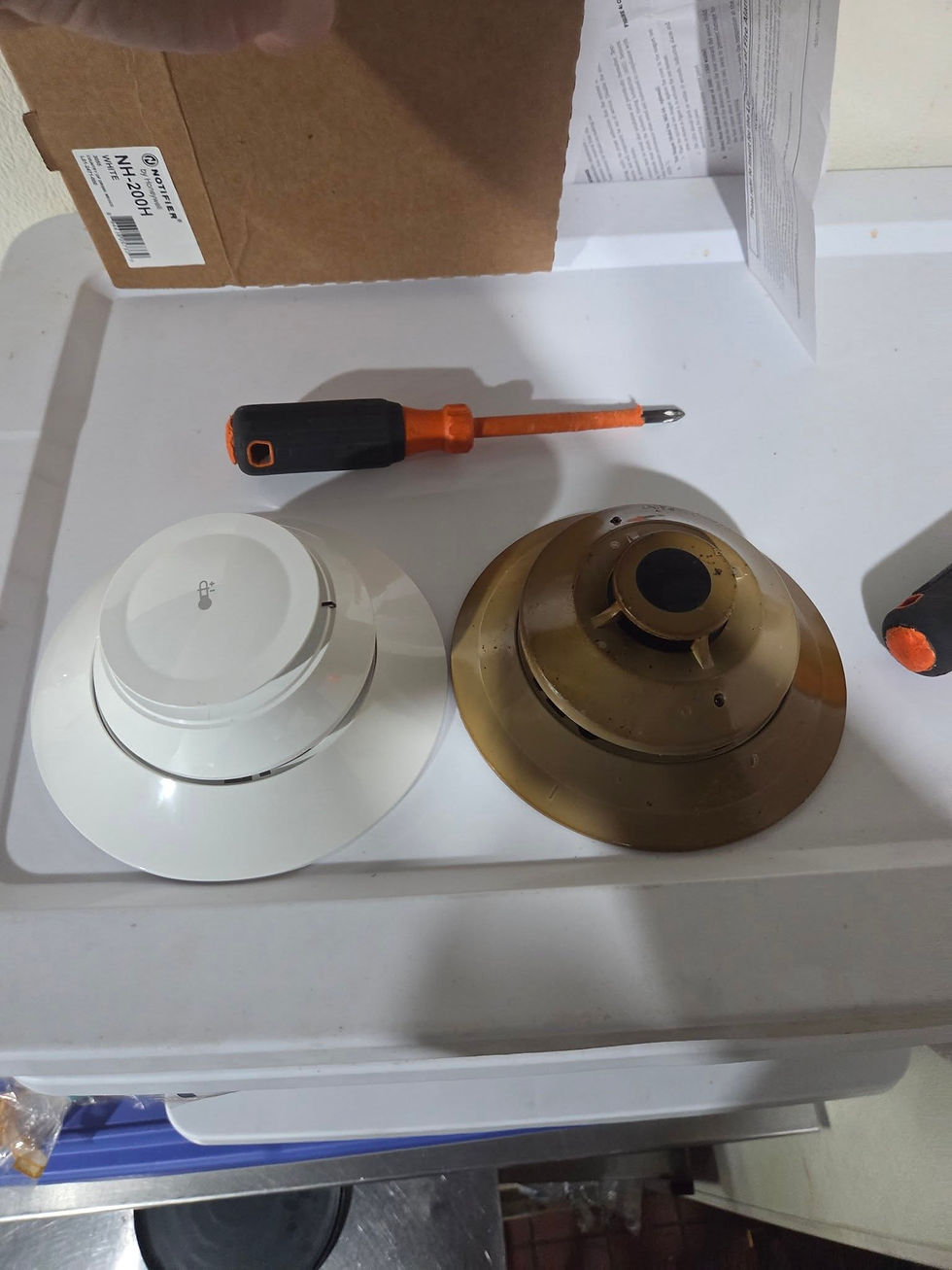
DetectionTech recently completed a fire alarm device replacement at a Connecticut restaurant where grease buildup had compromised every detector above and near the cooking line. The devices appeared intact from the outside — but the sensing chambers were heavily contaminated. Devices were replaced on the same visit and the system was brought back to full NFPA-compliant coverage.

Outdated devices — fire alarm detectors have a defined service life. NFPA recommends replacing smoke detectors after 10 years. Many restaurants are operating with detectors that are well past this threshold.
Incorrect detector placement — heat detectors rather than smoke detectors are required directly above cooking equipment. If smoke detectors were installed where heat detectors should be — a common mistake by unlicensed installers — the system is both non-compliant and likely to generate nuisance alarms from normal cooking activity.
Panel issues — the fire alarm control panel may have fault conditions, battery failures, or communication issues that aren't obvious without a proper inspection.
Missing or non-functional pull stations — pull stations are required at specific locations throughout a restaurant and must be tested during every annual inspection.
What ConnecticutRestaurants Are Also Required to Have Beyond NFPA 72
NFPA 72 covers fire alarm systems — but Connecticut restaurants with commercial cooking equipment are also subject to requirements for kitchen fire suppression systems under NFPA 96 Standard for Ventilation Control and Fire Protection of Commercial Cooking Operations.
This means Connecticut restaurant owners typically need to coordinate two separate annual inspections:
NFPA 72 fire alarm inspection — covers smoke detectors, heat detectors, pull stations, notification devices, control panel, and monitoring. DetectionTech handles this.
NFPA 96 hood suppression inspection — covers the Ansul or similar chemical suppression system above the cooking equipment. This is typically handled by a fire suppression specialist and is required every 6 months for most commercial cooking operations.
DetectionTech handles the fire alarm side and can advise on coordinating the suppression inspection with the appropriate vendor.
How to Prepare for Your Annual NFPA Fire Alarm Inspection in Connecticut
Know when your last inspection was — if you don't have a copy of your last compliance report, you may be overdue. Most restaurants should have an annual inspection date that ties to their initial installation or first inspection.
Have your system documentation available — the original installation drawings, previous inspection reports, and any service records help the inspector work efficiently and identify changes that may have been made to the system since the last inspection.
Clear access to all devices — ensure detectors, pull stations, and the fire alarm control panel are accessible. Kitchen equipment, shelving, and storage that blocks access to devices slows the inspection and may result in devices being flagged as inaccessible rather than tested.
Plan for some disruption — the inspection process includes testing notification devices — horns and strobes will activate during testing. Let your staff know in advance and consider scheduling the inspection during a slower period.
NFPA Fire Alarm Inspection Services DetectionTech Provides for Connecticut Restaurants
DetectionTech is a licensed Connecticut fire alarm installer providing annual NFPA fire alarm inspections for restaurants throughout all eight Connecticut counties. Our inspection services include:
Full NFPA 72 annual inspection and testing
Grease buildup assessment and device cleaning or replacement
Pull station, horn, strobe, and notification device testing
Fire alarm control panel functional test and battery backup verification
Monitoring connection and signal transmission verification
Formal compliance documentation produced on the same day
Device replacement for any deficiencies found — often completed in the same visit
We serve restaurants throughout Connecticut including Fairfield County, Hartford County, New Haven County, and all surrounding areas.
Schedule Your Annual NFPA Fire Alarm Inspection Today
If your Connecticut restaurant hasn't had a fire alarm inspection in the past 12 months — or if you're not sure when the last one was — it's time to schedule one. NFPA fire alarm inspection requirements for Connecticut restaurants exist for good reason, and DetectionTech makes compliance straightforward.

Comments